Sunday, December 30, 2012

Maya News Updates 2012, No. 2

Some of the Major Discoveries in Maya Archaeology of 2012: Tak'alik Ab'aj, Tobacco, Xultun, La Corona, El Zotz, Uxul, El Peru, and Dzibanche
The second, and last, posting for 2012 is my short illustrated overview of some of the major discoveries in Maya archaeology made in or reported on this year.


In January of 2012 archaeologists Christa Schieber de Lavarreda and Miguel Orrego Corzo reported on the 2011 excavation of a special offering deep inside Structure 6 at the site of Tak'alik Ab'aj, Retalhuleu, Guatemala. Among the objects that composed this offering was an impressive necklace. According to the archaeologists the necklace, part of the objects associated with a (re)burial of an infant, was probably deposited in a period of circa 190BC-AD10 (based on a C14 date, generated from the contents of a vessel excavated within the same context).


In January of 2012 as well an important article that was to appear in an upcoming issue of the journal Rapid Communications in Mass Spectrometry (Volume 26, Issue 4, pages 403–411, issue date of February 29, 2012) was brought to the public's attention. It reported on recent trace element research by Dmitri Zagorevski, director of the Proteomics Core in the Center for Biotechnology and Interdisciplinary Studies at Rensselaer, and Jennifer Loughmiller-Newman, at that time a doctoral candidate at the University at Albany (now Ph.D.). In their research (executed in 2011) they discovered the first physical evidence of tobacco (more precisely, the detection of nicotine as being indicative of tobacco) in a Maya ceramic container. Even more, the container that contained the tobacco residue is marked with the short text yotoot[il] umay "(it is) the home of his/the tobacco" (the small ceramic flask was considered to be the "home" of the tobacco product; a variety of ceramic vessels is marked as otoot "home" [for instance see below, the small alabaster container found at El Peru]. The image above shows the side of the small flask with umay spelling [Kislak Collection, Library of Congress, Washington]).


In May of 2012 a most important archaeological discovery was reported from the site of Xultun: a small room that contained elaborately painted walls portraying various human protagonists and a series of small hieroglyphic captions. Among these captions were arrays of numbers, one being a portion of a lunar table. Especially the arrays of numbers (associated with various important cycles and multiples of well-known calendrical base numbers) sparked a host of comments and ideas at various websites, but the basic article on the discovery and workings of these numbers was published in Science (Vol. 336, No. 6082, pp. 714–717 [May 11, 2012]), entitled Ancient Maya Astronomical Tables from Xultun, Guatemala and written by William A. Saturno, David Stuart, Anthony F. Aveni, and Franco Rossi. One of the numbers gained great popularity as it recorded an amount of days (in Maya: 17.0.1.3.0) totaling 6,708 years of 365 days (thus adding fuel, in many senses, to the 2012 Maya calendar debate and the "actual" duration of the Maya calendar). (The first, severely eroded, portion of these murals was discovered in 2010 by Franco Rossi; some of the results of the 2010-2011 excavations were reported by William Saturno in July of 2011 in Paris at an international symposium on Maya archaeology. Saturno is of course well-known from the discovery and subsequent excavations of the murals at nearby San Bartolo.)


At the end of June of 2012 archaeologists Tomas Barrientos and Michael Canuto reported on the discovery and subsequent excavation of a significant portion of La Corona Hieroglyphic Stairway 2. This portion of the stairway, luckily missed by looters in previous years, brought a wealth of new information on the La Corona, anciently known as Saknikte', ruling court (as several of the blocks were inscribed), including a stone block (HS 2, Block V) that contained a reference to the Calendar Round 4 Ajaw 3 K'ank'in (Uniiw), the date associated with the completion of the thirteenth bak'tun, the well-known 2012 date. This text became the second now known reference to 2012 in the corpus of Maya hieroglyphic texts. The surviving inscribed blocks of HS 2 (all re-set, in no particular or apparent order, and coming from different contexts) provide many more interesting feats, for instance (in my opinion) two additional portraits (Blocks VII and VIII) of Calakmul/Kanu'l king Yu'kno'm Ch'e'n.


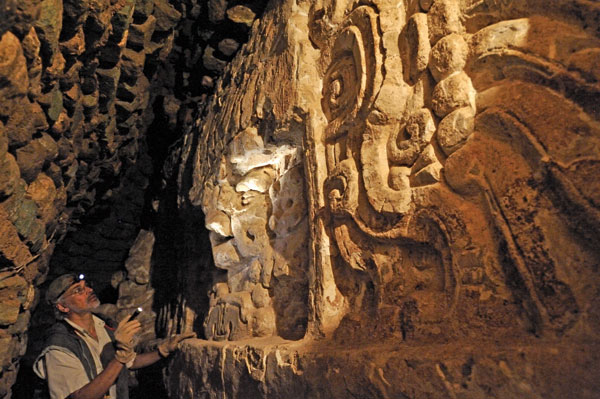
In July of 2012 the Instituto de Antropologia e Historia de Guatemala (IDEAH) held a press conference in which the latest discoveries at the site of El Zotz were made public. At the building dubbed El Diablo (by Andrews in 1986, not by the present project) archaeologists, this year under the direction of Edwin Román and Thomas Garrison, continued their research (earlier at this building the important tomb of a king had been found in 2009). At the press conference the IDEAH announced the discovery of a series of stucco masks which portrayed the Sun God in different manifestations. The stucco masks and facade belong to a building probably erected circa AD350-400, which covered the earlier tomb and may have been part of a commemorative building program in honor of the occupant of the tomb. Based on dozens of photographs and measurements derived from the excavations it was Stephen Houston, Brown University, who prepared the first partial reconstruction of the Sun God facade.


Also in July of 2012 the archaeologists working at Uxul, Campeche, Mexico, reported the discovery of a finely furnished tomb in one of the southern rooms of Structure K2. The tomb contained the remains of a young person, who may have died at the beginning of the eight century AD (one of the vessels recovered from the tomb may contain a date in AD711). During a major part of the florescence of Uxul it was under the influence of the supreme royal court of Kanu'l at Calakmul. However, the tomb dates from after that period.


In October of 2012 the archaeologists David Freidel and Juan Carlos Pérez working at the site of El Peru (anciently known as Waka') announced that they had found the tomb of a well-known queen of the site. El Peru's Stelae 33 and 34 are now in public collections in the US (looted in the 1960s); Stela 33 (looted in the 1960s, appeared on the US art market in 1969, acquired by the Kimbell Art Museum in 1970; inv. AP1970.02) portrays king K'inich Bahlam II, while Stela 34 (looted in the 1960s, appeared on the US art market in the middle 1960s, acquired by the Wade Fund for the Cleveland Museum of Art in 1967; inv. 1967.29) portrays his wife and queen, nick-named Ix K'abel by some epigraphers (based on the HAND-le spelling). As the archaeologists noted, a small alabaster vessel (shaped as a shell from which an anthropomorphic head emerges and functionally identified as a yotoot[il] "the home ..."; see above, yotoot[il] umay) in the recently excavated tomb contained a short text that mentions her name, K'abel (I prefer "Lady Waterlily Hand", only paraphrasing the majority of the constituent parts of her name), who was also entitled Ix Kanu'l Ajaw "Lady King of Kanu'l (court at Calakmul)". The small container and name caption (as well as other objects inside and outside the tomb) may thus identify the occupant of the tomb, as the archaeologists suggest. (Both stelae were looted from El Peru at some time in the 1960s; it was Ian Graham who found the sawn off sides of both stela still in situ at the site in the 1980s.)


In November of 2012 the Instituto Nacional de Antropología e Historia (INAH) announced that information derived from the most recent excavations at Dzibanche, Quintana Roo, Mexico, indicated that the site was occupied well into the thirteenth century AD, two centuries later than previous thought. Additionally the INAH announced the discovery of several important cultural artifacts, among them an impressive stucco mural, made in this and previous years at the site. (The INAH bulletin also discusses in short the "Maya collapse" and uses the new discoveries at Dzibanche to modify the occurrence and timing of that collapse. "Collapse" as a cultural/societal phenomenon is not easily defined, but it never seems to have a single cause nor does it seem to happen overnight. The "Maya collapse" was, as I see it, multi-causal and depending on the region within the Maya area, "it" happened earlier or later, or seemingly even never happened, and had a duration spanning either a short or a long period with intermittent periods of resilience and re-establishment of populations ... "collapse" is thus not a simple singular event with an easy detectable and straightforward time and/or event line.)

These are the eight major Maya archaeological discoveries that I have chosen to include in my overview of 2012. There were many more small and big discoveries, confiscations or repatriations of looted objects (among them three small panels from La Corona; the return of six additional panels, now in Italy, is being negotiated), etc, etc. I hope that 2013 (and beyond) will bring me the time to report on all the things, old and/or new, yet to be discovered in the Maya area.

Tuesday, October 13, 2009

Maya News Updates Banner 2007
Maya News Updates 2009, No. 37: Leiden, Netherlands - Exhibition "Maya 2012" Opened to the Public
On October 7, 2009, the exhibition "Maya 2012, het mysterie van een eeuwenoud volk" (Maya 2012, the mystery of a centuries old people) at the Museum of Ethnology in Leiden, the Netherlands, was presented to an invited audience and the press. On October 9, 2009, the exhibition was opened to the general public.
The exhibition is centered around the theme of the well-known date 13.0.0.0.0, 4 Ajaaw 3 Uniiw, a date which through the correlation constant 584,283 can be transposed to the Christian (Gregorian) date December 21, 2012. And that date has become of importance in recent years, in which many a "doomsday" scenario has been described. Not so at this exhibition, which targets a young audience of 8 to 15 years, accompanied by their elder brothers and sisters, their parents, and grand parents. This exhibition, simply said, invites the family.
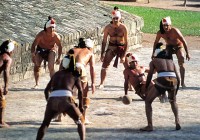
On a relatively small surface the exhibition shows Precolumbian and present-day objects from the Maya area, all part of the museum collection. The exhibition has a thematic approach and through different themes it introduces the visitors to different aspects of Maya life and culture, for instance Life and Death, Kingship, and the Ballgame. The exhibition is interactive and especially for this exhibition a Dutch software company has developed a "Maya ballgame" application in which the participants (one to one) will wear a protective belt and an arm protector (like the ancient Maya ballplayers). The ballcourt setting ... the Great Ballcourt at Chichen Itza.
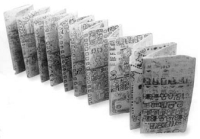
Touch screen monitors are placed strategically throughout the exhibition, providing more in-depth information on the different subjects. The Precolumbian Maya objects are exhibited in special show cases and all can be walked around to see the object in full detail. Each show case carries a number through which the explanatory text can be found in the accompanying large, fold-out flyer. Several glyphic texts of some of the Maya vases have been drawn for this occasion and have been integrated into the flyer (the drawings are mine, as I have worked as a consultant during the preparations of this exhibition).
Parts of the exhibition that particularly draw the attention are the Maya sky at night in which the ancient "Maya constellations" are portrayed through a fluid computer animated presentation, the close to life-size reconstruction of the inside of Structure 1, Room 2, at Bonampak (with the reconstructed mural paintings by Heather Hurst beautifully printed on canvas), the position of La Pasadita, Lintel 2, accompanied by an animated and colored wall projection and auditory explanation explaining the contents of both iconography and written text, and the show case presenting the famous Leiden Plate. This corner of the exhibit connects with a basic explanation of the Maya calendar and calculus. The the king's portrait on Leiden Plaque has been painted on the back wall, accompanied by a "sectioned and colored copy". Each section (parts of the headdress, wristlets, anklets, belt, etc.) can be lifted from the king's portrait and the back provides the explanatory text what part of the king's costume it is.
The final part of the exhibition shows the one Classic Maya text (through an enlarged black-and-white drawing) that records the date 13.0.0.0.0, 4 Ajaaw 3 Uniiw in 2012 (with as caveat, if our current understanding of the correlation between the two calendars is correct of course). And here I will add more detail and my personal opinion on the text (my opinion and knowledge is based on personal research on Maya culture in general and Maya epigraphy in particular for many years as well as conversations and email exchanges with many Mayanists on the subject of this text as well as related subjects; at the 2005 European Maya Conference in Geneva, Switserland, I hosted a workshop on the subject). This text is the final part of a longer inscription (known as Monument 6, possibly a T-shaped wall panel) from the site of Tortuguero, located in the Mexican state of Tabasco. During its apogee in the Late Classic, the time period in which this text was produced (the main text records historical dates and events from A.D. 612 to A.D. 667; the side panel records a date in A.D. 510, after which a Distance Number follows to connect the event to A.D. 2012), the site had a strong connection with the site of Palenque (both royal houses employ the same paramount title), located in the Mexican state of Chiapas. To me this is of great importance when we consider the putative 2012 date at Tortuguero. Several texts at Palenque, written during the reigns of various kings, refer to another 13.0.0.0.0 date, the one on 4 Ajaaw 8 Oohl, or August 11, 3114 B.C. (same correlation, 584,283; Gregorian). The Maya scribes, as instructed by their royal patrons, recorded the mythical events before, on, and after that very early date. From these events, and the mythological participants in these events, the Palenque kings derived their royal legitimacy. However, these events concerning 4 Ajaaw 8 Oohl are only covered in short, summary statements, the precise meaning of some of these events still eludes us or are hieroglyphically transparent (we can decipher all glyphic parts) but in meaning it remains opaque (the resulting word has many meanings which may be applicable, or the word does not exist anymore). These particular texts, written and inscribed under the patronage of Palenque kings K'inich Kan Balam and K'inich Ahkuul Mo' Naahb' III, most intriguingly open with these events relative to 13.0.0.0.0, 4 Ajaaw 8 Oohl, in 3114 B.C.
The Tortuguero monument seems to do something comparable. The final part on the 2012 (actually 13.0.0.0.0) date is very short, just 8 glyph blocks describe the date and the events that are related to this date. The much longer preceeding text (most probably when the monument was in one piece and T-shaped) covers over 175 glyph blocks detailing important events in the life of Tortuguero kings. Thus less than 10% of the text tells us, in the present-day, about 13.0.0.0.0, 4 Ajaaw 3 K'ank'in in 2012. If it was a wall panel, it would have been placed in a private setting and the contents of the text was not meant for eyes at all ... More importantly, the 13.0.0.0.0, 4 Ajaaw 3 Uniiw, in 2012, date and events are recorded AT THE END of the text.
Where at Palenque the texts OPEN with events before, on, or just after 13.0.0.0.0, 4 Ajaaw 8 Oohl in 3114 B.C., the text at Tortuguero CLOSES with the events on 13.0.0.0.0, 4 Ajaaw 3 K'ank'in in 2012. The integration of these very important dates, calendrically but also mythologically, seems to be some kind of literary device. "From the olden times" (Palenque) to the "new times" (Tortuguero); these dates thus frame HISTORICAL events (the dates and events "in the middle") and the kings that employ these dates, and record the associated events and the names of the mythological participants, derive their legitimacy from them.
So, what does that final event, in 2012, recorded at Tortuguero actually tell us? First of all, and very importantly, this part of the text suffers from erosion and breakage. This breakage even has resulted in the fact that parts of this text are housed at different locations in the world; part in a museum in Villahermosa, Mexico (where it is on exhibit), while another part resides in the USA in a private collection (luckily, there are photos ... and no, I have not seen the fragment). But .... the final part of the text tells us that 13 calendrical periods named pik (aka. bak'tun) are completed on the date 4 Ajaaw 3 Uniiw. On this date something will happen ('u-to-ma, for utoom), somewhere ... but the name of the possible location is eroded (and epigraphers do not even agree if indeed this is the name of a location or that it spells something completely different). The text continues with what seems to be a spelling ye-ma, but which for the same calligraphic reasons (long inner lines and rotation of the sign; and considering erosion) may read ye-he (possibly a former je sign; at the end of the Classic period /j/ and /h/ merged). Both lead to viable readings, ye-ma to yemal "(is the) descent of" and ye-he to yehet/yeht perhaps meaning "together with" (research on the meaning of -eht continues, as does research on the root em-). What follows this statement is the name of a god, Balun Yokte'; in other texts his name is recorded in full as Balun Yokte' K'uh, in which k'uh means "god" (and we now can enter a debate if the "god-concept" among the first Spanish frairs, who composed the earliest dictionaries in the 16th century, is the same as the "god-concept" among the Maya, or Mesoamerica for that matter).
Epigraphic research has shown that Balun Yokte' K'uh is a god (...) who is connected to war and the transition of time periods. One text at Palenque even connects this god to an important mythological (read "not historical", although now we can enter yet another debate) event some 900,000 years in the past. The final glyph block opens with the sign ta, probably spelling the preposition ta "in, for, with," but what follows, the very last glyphic signs, nearly is eroded beyond recognition. Only a few inner lines remain, even the outher cartouches are incomplete.
The "prophecy" of 2012, that one Classic Maya text on the date 13.0.0.0.0, 4 Ajaaw 3 Uniiw, is incomplete. We have just sniblets on this date and its associated events. Not even story can be recorded in 8 glyph blocks, maybe just the main words of a much longer headline that recalls the story of what will happen on that date. Just as we have only fragmentary (but still more than ...) information on that other date in Maya time reckoning, 13.0.0.0.0, 4 Ajaaw 8 Oohl, in 3114 B.C.
So, what happens after? Well, it all continues. Even the Maya told us. For instance, at Palenque king K'inich Janaahb Pakal records a date into the future and well after 2012. And with excavations going on in the Maya area most probably the next discovery brings us a new text and yet another pespective on these events described above, or any other event for that matter. We are learning, and we keep learning. As 13.0.0.0.0, 4 Ajaaw 3 Uniiw, is not the end of the Maya calendar or Maya culture or the world as we know it, let this date and its fascinating circumstances not be the end of our learning, understanding, ansd appreciation.
Now go see this exhibition! ;) And there is not only an exhibition, it is accompanied by a website and a television series (an adventure-detective story, televized in 12 episodes by the AVRO). But the exhibition is in Dutch ... well, yes, and no. All important explanatory texts are in English as well.
Learning about 2012 is one in this exhibit, getting to know the Museum of Ethnology's Maya collection is two, and experiencing this exhibit and its interactive showcasing is three. Three, yet another magic number. But that is a different story ...
Below (the) Dutch readers/readers of Dutch can find the review of the exhibit as was published today, October 13, 2009, in the Dutch daily newspaper De Telegraaf.

Wednesday, April 14, 2010

Maya News Updates Banner 2007
Maya News Updates 2010, No. 17: New Book on 2012, Mark Van Stone "2012: Science & Prophecy of the Ancient Maya"
Hot of the presses is the book by Mark Van Stone on 2012, aptly entitled "2012: Science & Prophecy of the Ancient Maya". Below you find the cover of the book, illustrating photographs of the fragment that together form the side panel of Tortuguero Monument 6 that refers to the 2012 date (also to be included in the catalog that will be published soon and which accompanies the Dutch exhibition on 2012 in Leiden, the Netherlands). The flyer provides the contact information to order this book (also available in electronic format).
The book is self-published by the author. It is full color, about 170 pages long, softcover 8.5" x 11", and ships for $49 postage included (US). Mark Van Stone has written extensively on 2012 on the website of FAMSI. This book is the final result of his years of research.

Saturday, December 31, 2011

The Comalcalco Brick: Not a 2012 Text
In earnest, I was not planning to write any further online comments on the Comalcalco Brick text. But seeing that again my views are misrepresented and that pseudo-scientists use this text in their "Maya Doomsday Prophecies," unfortunately on the last day of 2011 I see myself forced to write the following comments.
In a series of emails from December 2009 (part of exchanges in regard to Tortuguero Monument 6 and 2012), I introduced a short text that perhaps (and only perhaps) was related. As certain people (those to whom I have written and even those who receive them through a person to whom I have written, but who I did not give permission to share) have used some of my emails without my permission and without my knowledge, I will simply share the contents of the most important emails on the Comalcalco Brick in chronological order so one can see how an idea develops, how an argument is built, and how reservations/stipulations are formulated:

December 5, 2009 (written to seven Mayanists):
"And now I am looking for your help. While searching for something completely different I came upon the following drawing in my archive. Except that it is named COL - Unknown - Incised Text, I know nothing about it, not even from where I got this drawing ...
But intriguingly, the short 4 glyph text may open with 4 Ajaw 3 [Animal Head] ... Compare the main sign of the month sign with the howling dog/kinkajou main sign sign for the month Uniw at Chinikiha (Throne, B1) and Piedras Negras (Altar 2, D2). Or is it a bat head without the leaf-nose ...
It would be so nice to have a second 4 Ajaw 3 Uniw ..."

December 9, 2009 (by now it was clear that the text appeared on a clay brick from Comalcalco and that the brick was illustrated in Steede's 1984 catalog "Catálogo preliminar de los tabiques de Comalcalco" [any addition to the original text is placed between square brackets; bold added for clarity]):
"As I wrote in a[n] earlier message, yes, I have contemplated Suutz' as a month name, but in that case a unique bat head without leaf-nose would have been employed. It would be nice to have the whole Steede catalog available and see what the Comalcalco corpus has for us rega[r]ding calligraphy and rare signs. […]
And let us just focus on that for a bit of time. As we only have the drawing, and I take the one I send around as the best available at present. On what can we be certain:
= the opening collocation shows the tzolk'in date 4 Ajaaw. No doubt. See attached brick for a 3 Muluk date with same cartouche.
= the second collocation opens with a number 3, followed by an animal sign that should provide the month name for the haab date. Month names that have or can have animal head main signs are (4) Suutz'(il), (6) Xul/Chikin, (14) K'ank'in/Uniiw, (15) Muwaan, (16) Paax(il), and (17) K'ayab/K'anasiiy. Of these I seriously only consider Suutz' and K'ank'in/Uniiw. The absence of the leaf-nose on the bat head at present directs my identification to Uniiw. But this IS tentative.
If so, the date would be 4 Ajaaw 3 Uniiw. Possible candidates for the Comalcalco date range (AD 649 - AD 814, based on TRT monument 6 Comalcalco conquest and CML brick no. 3 with Bakal/el king mentioned) ... well, within any bak’tun the CR 4 Ajaw 3 Uniw [dates] are winal completions, not a thing recorded too often in Maya inscriptions. Only on a few occasions it is a tun ending. And only at 13.0.0.0.0 it is a bak’tun completion ... The alternative 4 Ajaaw 3 Suutz' occurs 5 times (date range extended to AD 600-900).
= the third collocation, per Christian [Prager]'s suggestion, indeed seems to be hu-li, employing the "upended-frog" for hu- followed by a common -li sign.
= the fourth collocation as the largest sign has a tzu, or more neutrally, a tzu-like sign. In the upper left corner there might be a doubler. The remainder seems to consist of two signs. My suggestion -jo-ma is very tentative, VERY. Only a photograph would help to identify the actual signs. This collocation ultimately may not spell a second verb at all ... but a personal name...
In sum, I rather like the 4 Ajaaw 3 Uniiw identification. First, because Comalcalco is located in the Bakal/el region, in which Palenque provides the 4 Ajaaw 8 Hulohl dates and Tortuguero the 4 Ajaaw 3 Uniiw date. It keeps it in the family! Second, a CR 4 Ajaaw 3 Uniiw is not rare, it occurs every 52 years and then nearly always is a winal completion. And a record of that would surprise me, especially as there are no other records of a CR 4 Ajaaw 3 Uniiw ... […]."

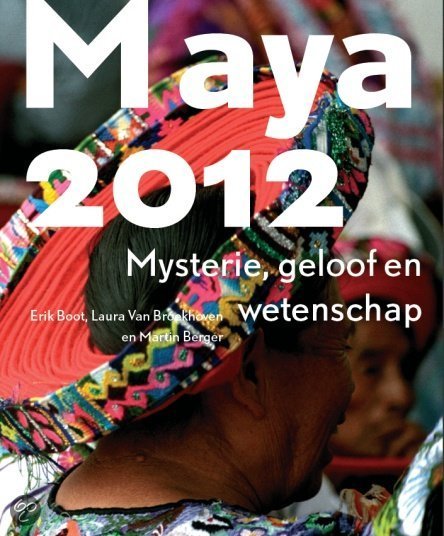
With all these stipulations it became part of a research manuscript in Dutch. This was work in progress. Again, in this manuscript I mention all the stipulations (below the English translation, slightly adjusted from a previous translation made in great haste; this text has not been published in this format, it was summarized, but with my stipulations intact it became part of the catalog for the exhibit "Maya 2012" at the Museum of Ethnology in Leiden and was published in early 2011 by KIT Publishers, Amsterdam):

"Final Remarks:
Monument 6 from Tortuguero contains a text that refers to the date 13.0.0.0.0, 4 Ajaaw 3 Uniiw in 2012. The probable contents of this text is "complete will be the thirteenth bak'tun (on 13.0.0.0.0) 4 Ajaaw 3 Uniiw; happen will that seen is the presentation of Balun Yokte' K'uh in the grand ceremony."
This reference was carved on a monument that most probably was placed inside an inner room to which access was restricted. The text could only be read by a select group of Maya, the kings, their relatives, priests, and court officials. This text was and is not intended for our eyes. The text also does not indicate that an "ending" is coming; it is just a point in the Maya calender on which the thirteenth bak'tun will be complete. The count of days will just continue. Based on another inscription in Palenque we know that the Maya placed dates far into the future, in a year A.D. 4772, a long time after 2012.

Research on this text continues and in this research possibly new readings, and thus new interpretations, will be presented. [...] It is even possible that another text on 2012 will be found. And, very tentatively, this already may have happened. A ceramic tile from the site of Comalcalco, as I recently noted, may possibly refer to the Calendar Round date 4 Ajaaw 3 Uniiw, followed by two hieroglyphic collocations (Figure 8 [see the image posted below, right]). (note 18) There is no calendrical information to be found on this tile that it indeed concerns 13.0.0.0.0, 4 Ajaaw 3 Uniiw, but the importance of the Calendar Round date 4 Ajaaw 3 Uniiw would not have escaped the attention of any high placed Maya at that time. (note 19) Comalcalco was also a part of the Baakal (Baakel) kingdom and that kingdom produced Tortuguero Monument 6.
[...]

18 (italics added for clarity)
The texts opens with 4 Ajaaw, followed by 3 Uniiw. The main sign for Uniiw is an animal head and in my opinion only Uniiw is to be considered (other months with prominent animal heads are Zotz', Xul, Muwan, and K'ayab). The third hieroglyphic collocation seems to be hu-li (an opinion I share with Christian Prager) and the fourth hieroglyphic collocation seems to open with 2tzu for tzu-tzu, tzutz-. The last two parts could be -jo-ma, but without a good photograph of this tile this is just conjecture (and older drawings of Monument 6 have led to incorrect readings and interpretations!). The search for that photograph (and the tile itself) has begun.
19
In the Maya calendar the date 4 Ajaaw 3 Uniiw is a winal-ending (one time per 52 years, for instance on 9.14.1.17.0, 4 Ajaaw 3 Uniiw (November 2, A.D. 713). One time per 18 x 52 years it is a tun-ending (for example on 10.12.11.0.0, 4 Ajaaw 3 Uniiw (August 5, A.D. 1077) and only on 13.0.0.0.0, 4 Ajaaw 3 Uniiw it is the date on which the thirteenth bak'tun will be complete."

Through email I asked Carlos Pallan of AJIMAYA (INAH, Direccion de Arqueologia) in early 2010 if he could help me find a photograph of the brick and/or tracking down the brick itself. I also described in short my tentative research findings, the background why I was looking for this brick text, and I also sent him the Dutch manuscript containing all pertinent illustrations.

When my idea (it was nothing more than that, a working hypothesis, with many reservations) was discussed in the press (INAH, through Carlos Pallan; INAH bulletin of July 6, 2010 "Mayas no citan fin del mundo") or following that at Aztlan (comments by Marc Zender) none of my reservations or stipulations were mentioned. Pallan brought my idea "into the world" while I never gave him permission to do so (independent of the fact that I am not even mentioned in the INAH bulletin). Zender provided comments on the comments of others, without knowing anything of what I had written. Which he could have asked by simply dropping me an email. I was oblivious of this all, as I do not subscribe to Aztlan and only rarely check it. It prompted my reaction (after friends directed me to the Aztlan postings; I had not even had the time to formulate a reaction in regard to the INAH bulletin. None of my stipulations actually appeared in the Gronemeyer and MacLeod note on Tortuguero Monument 6 as published by Wayeb Notes, and they did receive my emails (cited above).
On invitation, I was asked to write a short article on the brick text for the journal Archaeoastronomy, in which I could provide a complete epigraphic analysis and in which I could place the brick text in perspective. In doing research for the article I discovered that in fact there are two rather different drawings of the brick. What I thought was the drawing from the catalog (which others thought as well), it was not (in the composite below, the drawing on the left is from the 1984 catalog). The two drawings are comparable in how they represent the opening Calendar Round, but drastically differ in how they represent the next two collocations and any reading of those collocations became even more tentative.

Just compare the third collocation in each drawing. Would you dare to read hu-li in the first drawing? Of one drawing (the drawing with which this all started; on the right) I still do not know who the artist is and where it has been published. I concluded that article with the following statement: "But all of the above suggestions are tentative, as the whole analysis is based only on two drawings. As such any reanalysis of Maya mythology and/or associated astronomical events regarding the 13.0.0.0.0 date in 2012 has to wait for a photograph (and the brick itself) to surface." The manuscript was submitted on August 8, 2011.

So, I kept searching for a photograph myself and continued with the source of one of the drawings, the 1984 catalog, and its compiler. To make a long story short I succeeded in contacting the compiler and I received a scan of the photograph of the Comalcalco brick. It was early November 2011. At that time I was preparing my presentations at the upcoming VII Mesa Redonda de Palenque and the 16th EMC in Copenhagen and November 20th I traveled to Mexico. Anything I wanted to write on the brick text just had to wait. (Boy, was that a mistake ...)

As I was told on November 27, the first day in Palenque, on November 24, 2011, the INAH posted a press release in which they wrote that the brick was located, that it did contain the Calendar Round date 4 Ajaw 3 K'ank'in (Uniiw) and that it did reference 2012. Now comments were provided by David Stuart, who, like others (but Christian Prager was first! Also not mentioned) noted the hu-li spelling, but with the great benefit of some photographic record of the original brick produced by INAH. Stuart, correctly, disassociated the Comalcalco text from 2012. The event recorded is in the past, not the future. And after that, as friends alerted me, also comments appeared in blogs, some of them submitted by Stanley Guenter. Reading these comments it became clear to me that Guenter had not investigated anything in-depth before he posted his initial comments and followed in the footsteps of Zender's comments at Aztlan. Just a little bit more effort would have brought him to my comments as posted at Aztlan and thus they could easily have been integrated. After his initial comments he did post the link to my comments, but on the web a link as an afterthought does not work. The average reader already has formed his opinion on what he has read, and that opinion is based on something which was incomplete.
My "final" comments on the Comalcalco text, that is what I now will present. Intriguingly, not many have asked me for my opinion, except for one US based magazine (but apparently my answer was too late, "urgent" the subject line said ... great, I am traveling between countries for conferences). So here they are (nota bene: these transcriptions, transliterations, and translations are still preliminary and tentative ... while INAH states it has located the brick, I have not seen it, nor (a) photo(s) that they may have provided to others. I base my observations on the scan of the photo that was made available to me by the compiler of the 1984 catalog, for which I am very grateful, which supersedes the quality and epigraphic detail of the two drawings; that scan will be published in early 2012 in Archaeoastronomy):

A1: 4-day.'AJAW
A2: 3-month.K'ANK'IN/UNIW
A3: hu-li
A4: ?-tzu?-?-?

Chan ajaw ux uniiw huli ?-tzu?-?
"(On) 4 Ajaw 3 Uniiw arrived [...]"

The photograph, in my eyes and my humble opinion, confirms the Calendar Round date 4 Ajaw 3 Uniiw. It also confirms Christian Prager's identification of the verb at A3 as hu-li (he was the one who suggested that first), leading to hul-i "arrived" (we can debate if the final -i was pronounced or not, but let's leave that discussion for another occasion; the Calendar Round, in my humble opinion, functions as a temporal adverb and thus the date is in the "completive"). The final collocation most probably spells a name or a title (as I, alternatively, already suggested in my December 9, 2009, email).

The Calendar Round date 4 Ajaaw 3 Uniiw targets a past date, not a future date. Possibly, considering the date-range reconstructed for Comalcalco (see above), this date was:

9.11.9.4.0, 4 Ajaw 3 Uniiw (November 16, A.D. 661) or
9.14.1.17.0, 4 Ajaaw 3 Uniiw (November 4, A.D. 713)
(corr. 584,285; Gregorian; other alternatives can be 52 x 365 days, or multiples thereof, earlier or later, but should fall between ca. AD 600-850)

Thus to conclude: The Comalcalco Brick Text does not reference a date in 2012. It is a 4 Ajaw 3 Uniiw date, but having passed in AD 661 or AD 713 (or +/- 52 years).

Research on the brick text continues (cracking the last collocation in all its detail, probably a title or personal name). A more definitive epigraphic analysis will appear as a Postscript to my earlier article that will appear in Archaeoastronomy. In the mean time I have taken up new projects, but I need to be smarter about with whom I share unfinished thoughts. Have a blast in 2012, and ... what will you have for breakfast on the day 13.0.0.0.1, 5 Imix 4 Uniiw?
Erik Boot
Independent researcher

Friday, December 21, 2012

Maya News Updates
13.0.0.0.0, 4 Ajaw 3 Uniiw
December 21, 2012. Rijswijk, Holland

Here in Holland the midnight hour has passed, it is now the 21st of December, 2012. (But it is probably more relevant to wait to sun rise.) The curtain has fallen (well ...) for the Dooms Day fear mongers and the self-proclaimed "prophets" who either predicted an end of the world through some horrible end-of-times scenario or some kind of spiritual awakening or transition (while I applaud the positivism in spiritual awakening and/or transition it is nowhere contained in ancient Maya texts). Supposedly this "end of the world" is based on ancient prophecies of the Maya, and ultimately to be found in one eroded text from Tortuguero (the La Corona reference is just the date, no associated description). So not true. If you need a resolution for the "last" days of 2012 or simply next year: Ask your money back from the authors and/or publishers for any book or item you bought in relation to 2012 that told you that a Dooms Day would be coming or some sort of Awakening or Transition! They ripped you off, they were "in the game" for the money, not to save you ... But no worries yet for those who want to fear or want to (be) awaken; December 21, 2012 is the 13.0.0.0.0 date in the 584,283 correlation (between the maya calendar and the Gregorian calendar). For the 584,285 correlation it would be December 23, and with the recently proposed 584,286 correlation it would be December 24. And still no worries after that, the 13.0.0.0.0 date will be associated with any upcoming date in our calendar. Those self-proclaimed "prophets" will make other calculations, or just simply tell you that the awakening has begun or that the transition is taking place. What a load of ...

Anyways. A long period of silence that has ensued at my blogs is hopefully over. For this there is a simple reason. This year of my life was reigned by a series of unfortunate events which made it impossible to do all the things that I like and want to do. Two operations on my back (the first on January 2nd) and subsequent periods of recovery seriously affected my ability to do any substantial work during the first half of the year. A third operation affected the early part of the second half. Managing to finish papers with dead lines on time or just after (thank you dear editors for the extensions!) as well as to present a couple of papers abroad (Paris, Gargano, Hamburg) meant that something had to give. What had to give were the blogs. Which was very unfortunate, because what a year it has been for Maya archaeological studies and our growing understanding of Classic Maya society (for instance the discoveries at Tak'alik Abaj, Xultun, La Corona, El Peru, and El Zotz'). As the archaeological projects at these sites will continue their research the coming years I am sure that more important findings will be made. And those new findings will be reported on at Maya News Updates in 2013 and years beyond (I hope).

Enjoy the Holidays, which ever one you prefer,
Erik

Sunday, December 30, 2012

Maya News Updates 2012, No. 1

 
Exhibit "Maya III - Life, Death, Time" at the Didrichsen Museum, Helsinki, Finland


On September 8, 2012 the exhibit "Maya III - Life, Death, Time" opened at the Didrichsen Museum in Helsinki, Finland. During the recent 17th EMC in Helsinki (December 9-16, 2012) an evening visit to this exhibit was planned by the organisers and I had the pleasure of seeing this wonderful exhibit. The exhibit has been layed out in five rooms at the Didrichsen Art Museum (Didrichsen Taidemuseo). Three rooms are dedicated to archaeological artifacts, one room to photographs by Jon Kaplan of Guatemala's Maya children, and one room is used for showing a documentary on the Maya.
A total of 121 archaeological artifacts are shown, a significant number of which has unfortunately no known provenience. The objects illustrate the three subjects of the exhibit: life, death, and time. The exhibit includes various objects of the Didrichsen collection (e.g., a Chochola ballplayer vessel; a polychrome vase; a small Jaina statuette; a K'iche' urn lid with armed warrior). Short explanatory texts accompany the objects, each associated with their catalog number. Most impressive among these objects is the lidded stone box (measuring 38 x 22 x 14 cm.) that was found in situ (containing the fossilized femur of a tapir) in the Hun Nal Ye Cave, Alta Verapaz, Guatemala. Discovered in early 2005 by Leonidas Javier (the owner of the land on which the cave is located), the stone box was stolen in 2005 or early 2006, but ultimately recovered (on May 31, 2006). The accompanying catalog is a hefty tome edited by Maria Didrichsen and Harri Kettunen. The catalog contains a variety of introductory and in-depth articles written by Arthur Demarest, Christophe Helmke, Harri Kettunen, Jon Kaplan, and Lindsay Renaud. Each article is lavishly illustrated and represents the current state-of-the-art in Maya studies. After the articles a complete catalog can be found, illustrating and describing all archaeological objects and the 23 photographs taken at for instance Chajul and Quetzaltenango. The catalog is trilingual (Finnish, Swedish, and English).
Below are my photographs of ten of the archaeological objects shown at the Didrichsen Museum exhibit (in no particular order). The exhibit opened on September 8, 2012, and runs until April 28, 2013. The museum is open from Tuesday to Sunday, its opening hours are 11-18 (on Wednesdays 11-20). The museum can be reached by car and taxi, but also by local bus transportation (bus lines 194 and 195 for instance, which leave from the Central Train Station).
Didrichsen Taidemuseo/Konstmuseum/Art Museum
Kuusilahdenkuja 1, 00340 Helsinki
+358 (0)9 4778 330
http://www.didrichsenmuseum.fi/eng/museum.php


Short description of the ten objects:
IM001: Naranjo, Altar 1 (replica), which opens with a date close to 24,000 years in the past and mentions an important but still enigmatic entity nicknamed "Square-nosed Beastie".
IM002: Dos Pilas, throne arm rest, portraying the Sun God K'inich Ajaw, set against a Solar Disk with centipedes at the corners. In his left hand he holds the head of a deer, possibly with a foot print on its forehead. Deer and peccary are associated with the Sun God as they carry the Sun on its path through the sky (in different seasons) (n.b., this is not a mutually exclusive association).
IM003: Didrichsen Collection: unknown provenience, Chochola-style vessel depicting a ballplayer (hieroglyphic caption mentions a title associated with Oxkintok).
IM004: Didrichsen Collection: Polychrome vessel of unknown provenience (probably central Peten).
IM005: Didrichsen Collection: Armed warrior on lid of urn, of unknown provenience (Highland Guatemala, probably K'iche' area).
IM006: Tikal, Basal Flanged Early Classic Polychrome Bowl, modeled as a turtle with water bird on lid.
IM007: Tikal, Basal Flanged Early Classic Polychrome Bowl, lid modeled as Maize God head.
IM008: Unknown provenience, polychrome vessel portraying Old God in Feathered Turtle Shell (formerly private collection, now at the Museo Nacional in Guatemala).
IM009: Hun Nal Ye Cave, central image on lid of the stone box, showing Maize God holding rabbit, which looks at the Moon (in which the number "30" has been placed, indicative of a lunation of 30 days).
IM010: Kaminaljuyu, part of a stone column found at Structure C-IV-8, shown is a detail of the head of an avian deity.

Tuesday, January 26, 2010

Maya News Updates Banner 2007
Maya News Updates 2010. No. 5: Plan de Ayutla, Chiapas - Archaeological Site Plan de Ayutla To Be Opened to the Public in 2012
Yesterday, Monday January 25, 2010, the Instituto Nacional de Antropología e Historia reported that Plan de Ayutla, a site unknown to many specialists until some seven years ago, will be opened to the public in two years. The site was first reported in 1974 en revisited in 1988; INAH started its project in 2003. The report provides additional information on the site, which has the largest ballcourt in this part of the Maya area (Alto Usumacinta) and may have been the capital of the Sak Tz'i' or Ak'e' kingdom (edited by MNU; photos INAH):

Plan de Ayutla abrirá en 2012 - Recientes exploraciones efectuadas por investigadores del Instituto Nacional de Antropología e Historia (INAH-Conaculta) señalan que el sitio arqueológico Plan de Ayutla, en Chiapas, pudo haber sido el centro político del que partió el linaje fundador de la ciudad maya de Bonampak, hace más de mil 400 años, hipótesis que se basa en la interpretación de inscripciones de diversos monumentos.
Esta zona arqueológica que será abierta al público antes de 2012 —de acuerdo con la lista de nuevos sitios anunciados por el presidente Felipe Calderón—, en la época prehispánica pudo haber sido alguna de las dos legendarias ciudades a las que hacen referencia los estudios epigráficos: Sak T’zi’ o Ak’e’.
La primera de estas dos hipótesis sobre la identidad de Plan de Ayutla, señala que pudo ser Sak T’zi’, ciudad que entre 600 y 800 d. C. mantuvo conflictos bélicos con las urbes mayas de Toniná, Piedras Negras y Yaxchilán, informó el arqueólogo Luis Alberto Martos. Este lugar ubicado en el municipio de Ocosingo, a 3.5 kilómetros de la actual comunidad tzeltal del mismo nombre, “es clave para entender el desarrollo y la integración política en el área de Bonampak y Lacanhá”, comentó el director del Proyecto Plan de Ayutla.
Plan de Ayutla, indicó el doctor Martos, tal vez correspondería a la mítica Sak T’zi’ (“Perro blanco”, en maya), descrita en diversos monumentos grabados, entre ellos el Dintel 2 de Yaxchilán, en el que se refiere la derrota que, precisamente Yaxchilán en alianza con Bonampak, infligió a Sak T’zi’, en 787 d. C. De acuerdo con las inscripciones —abundó—, “debiera ser un sitio mayor que Bonampak, pero menor a Yaxchilán. Algunos autores han trazado su área de influencia entre los reinos de Yaxchilán, Bonampak, Piedras Negras, Toniná y Palenque, justo en la zona donde se localiza Plan de Ayutla, por lo que dadas sus características existe la posibilidad de que se trate del propio Sak Tz’i’”.
Además, continuó el arqueólogo, “uno de los gobernantes de Sak Tz’i’, llamado K'ab' Chan Te', “El sostenedor del cielo”, se autodenominaba el soberano de los dos katunes —que en el calendario maya corresponde a 40 años, aproximadamente—, combatiente de juego de pelota. Es decir, que el juego de pelota era importante para Sak Tz’i’”. Este último dato cobra sentido si se considera que en Plan de Ayutla se ha localizado el juego de pelota más grande del Alto Usumacinta, el cual, incluyendo las estructuras que lo delimitan, tiene una longitud total de 85 m por 40 m de ancho, y se ubica en el centro de este asentamiento maya. Es de tipo cerrado y está recubierto con lajas.
Respecto a la segunda teoría, que hace alusión a que Plan de Ayutla sería también la legendaria ‘Ak’e’, el también director de Estudios Arqueológicos del INAH, señaló que este antiguo centro político estuvo subordinado en distintas etapas a la urbe de Toniná.
En Plan de Ayutla se distribuyen elementos arquitectónicos muy semejantes a los de Toniná, como el mencionado juego de pelota, las decoraciones en grecas de la Estructura 13 (la más impresionante del sitio) y el uso frecuente de altares tipo columna, por mencionar algunos, lo que lleva a postularlo como la remota ‘Ak’e’, que en maya significa “Tortuga”.
También, la proximidad con Bonampak —se encuentra a sólo 25 kilómetros de distancia— apunta a que de Plan de Ayutla (si fuese la antigua ‘Ak’e’) pudo salir el linaje fundador de Bonampak. Al parecer, dicha dinastía se trasladó llevándose el glifo emblema de ‘Ak’e’. De acuerdo con el doctor Luis Alberto Martos, en ambos casos se trata de lugares que no han sido localizados arqueológicamente, pero que —conforme han revelado estudios epigráficos— fueron importantes en la historia prehispánica de la región del Alto Usumacinta.
Una arquitectura monumental - Luego de algunas prospecciones y la liberación de un par de estructuras, realizadas en años anteriores, los trabajos arqueológicos en Plan de Ayutla se han venido efectuando de manera sistemática a partir de noviembre de 2008, con una inversión aproximada de un millón 200 mil pesos como parte de los proyectos especiales del INAH.
La evidencia arqueológica indica que en Plan de Ayutla hubo ocupación desde el año 150 a. C., aunque su historia como ciudad integrada comenzó 100 o 150 años después. A pesar de que la mayoría de las ciudades del Usumacinta fueron abandonadas hacia 800-850 d. C. Inclusive se han ubicado materiales que datan de 1000 d. C., lo que alude a su relevancia.
Perteneciente a la región de la Sierra de Jalapa, próxima a la Reserva de la Biosfera de los Montes Azules, este sitio maya posee características muy particulares que le brindan un carácter propio, como la calidad y monumentalidad de sus edificios que concuerdan con la arquitectura del estilo Usumacinta.
El arqueólogo Luis Alberto Martos destacó que la Estructura 13, localizada en la Acrópolis Norte, asemeja la forma de una choza. “Se trata de una soberbia construcción con dos crujías techadas e impresionantes bóvedas que alcanzan 8 m. de altura, rasgo inusual en la región. Al parecer, fue un observatorio ya que a mediados de julio (inicio del calendario maya) marca el paso cenital del sol”.
Emplazado en el corazón del Alto Usumacinta, Plan de Ayutla cubre un área de alrededor 25 hectáreas y consta de un total de 74 estructuras distribuidas en torno a tres acrópolis —que fueron edificadas aprovechando elevaciones naturales— y tres plazas principales, disposición que cumple con la cosmovisión maya de cielo, tierra e inframundo.
Hasta el momento se han excavado y restaurado (de forma completa y parcialmente) una decena de edificios de la Acrópolis Norte, entre los que destacan por su monumentalidad, las estructuras 1, 2, 3 y 13.
Ese complejo, junto con otras construcciones previamente consolidadas de la Acrópolis Oeste, más algunas de la Acrópolis Este —que se prevén liberar en este 2010—, conformarán la ruta de visita de Plan de Ayutla antes de 2012. (Modificado el lunes, 25 de enero de 2010 )(source INAH)

Saturday, November 06, 2010

Maya News Updates Banner 2007
Maya News Updates 2010, No. 32: New exhibition "Herz der Maya" opens on November 7 in Hamburg, Germany
The exhibition "Herz der Maya" opens on November 7, 2010, at the Museum für Völkerkunde in Hamburg, Germany. On the opening day there is a full program of presentations, music, excursions through the exhibition, and other activities. The website of the Museum für Völkerkunde (address: Rothenbaumchaussee 64, 20148 Hamburg) has a description and time table (only in German):
Ausstellungseröffnung "Herz der Maya" (07.11.2010 – 21.12.2012)
Ab dem 7. November 2010 schlägt das Herz der Maya in Hamburg. Das Museum besitzt eine der weltweit größten und bedeutendsten Sammlungen zur faszinierenden Kultur der Maya Mittelamerikas, die nun in einer neuen Ausstellung aufbereitet sind.
Auf über 700 qm wird ein Bogen von den Anfängen bis zur Gegenwart dieser geheimnisumwitterten Zivilisation gespannt. Auf der Reise von der klassischen Maya-Kultur bis zum jetzigen Mittelamerika können archäologische Schätze bestaunt werden und die enormen Leistungen dieser frühen Kultur werden erfahrbar. Von der vorspanischen Zeit gelangt man in die Zeit der grausamen Unterdrückung der Maya durch die Eroberung unter Alvarado. Das moderne Leben der heutigen Maya präsentiert sich in der originalgetreuen Nachbildung einer guatemaltekischen Dorfstraße mit Dorfmuseum, Schule und als Schlußpunkt der Dorfkirche.
Dazu erschließt sich auf der Reise duch die Maya-Welt Interessantes zu den Ursprüngen des Ballspiels sowie den bis heute reichenden Geheimnissen des Maya-Kalenders mit seinen rätselhaften Prophezeiungen, die für das Jahr 2012 eine Zeitenwende vorhersagen.

Eröffnungsprogramm
11 Uhr Grußworte von Dr. Gabriel Aguilera, Botschafter der Republik Guatemala Reinhard Stuth, Senator für Kultur und Medien der Freien und Hansestadt Hamburg
Prof. Dr. Wulf Köpke, Direktor des Museums für Völkerkunde

Musikalische Begleitung: Antonio Cosenza (klassische Gitarre) spielt Tänze und „Sones“ der Maya

11 – 18 Uhr Guatemaltekische und mexikanische Spezialitäten

12.15 Uhr „Land der ewigen Faszination – Forschen und Sammeln in Guatemala für das Museum für Völkerkunde“ – Vortrag von Prof. Dr. Bernd Schmelz

13 Uhr Tänze und „Sones“ der Maya von Antonio Cosenza

13.30 Uhr Die „Lieblingsobjekte“ des Ausstellungsteams – Kurzvorträge von Dr. Lars Frühsorge, Mónica Pacheco und Ulla Weichlein

14 Uhr „On the Road with Maruch“ (2008, Span. und Tzotzil, OmeU) Filmpräsentation im Anwesenheit des Regisseurs Florian Walter

14-17 Uhr Offene Werkstatt: Mayaspiele zum Mitmachen mit M. Cubas

14.30 Uhr „Blick hinter die Kulissen“ Führung mit Dr. Carl Triesch, Ausstellungskoordinator

15 Uhr Das „Making-of„ der Ausstellung „Herz der Maya“ – Führung mit Dr. Lars Frühsorge und Mónica Pacheco aus dem Ausstellungsteam

(Source Museum für Völkerkunde)

Sunday, November 07, 2010

Maya News Updates Banner 2007
Maya News Updates 2010, No. 33: Hamburg exhibition "El corazón de los mayas" ("Herz der Maya") Reviewed in La Jornada
The exhibition "Herz der Maya" opened today, November 7, 2010, at the Museum für Völkerkunde in Hamburg, Germany. The daily Mexican newspaper La Jornada posted a short review of the exhibition today, with some details on the history of the Hamburg museum collection (edited by MNU):
Se exhibe en Alemania uno de los acervos más completos de la cultura maya - Miles de objetos de la cultura maya han pasado décadas enteras en los sótanos del Museo Etnológico de Hamburgo, varios metros debajo de las espaciosas salas que albergan testimonios de los cinco continentes. Pero a partir de mañana el público podrá ingresar al mundo de este pueblo precolombino a través de El corazón de los mayas, una de las colecciones más completas de la actualidad.
“Las primeras piezas de arte maya llegaron a Hamburgo procedentes de Guatemala en 1878, años antes de la fundación de este museo”, explica Bernd Schmelz. Debido al café, las relaciones entre hamburgueses y guatemaltecos son muy estrechas y aún más antiguas. “Ya en 1828, numerosos maestros y comerciantes alemanes se establecieron en Guatemala”, señala el director científico de la institución.
Este contacto fue intensificado a nivel cultural por Franz Termer. Durante un viaje de investigación entre 1925 y 1929, quien más tarde se convertiría en el segundo director del museo hamburgués comenzó a coleccionar no sólo piezas arqueológicas, sino también objetos de arte y artículos que formaban parte de la vida diaria de uno de los pueblos más fascinantes de la humanidad.
Termer fotografió y filmó a los mayas durante sus quehaceres diarios y ceremonias. El etnólogo se convirtió en experto en su cultura y se interesó en especial por la producción textil de los mayas. La colección del museo se enriqueció en la última década del siglo XX mediante una donación de mil textiles, entre ellos coloridos huipiles y trajes para ceremonias con complejos trabajos de bordado y telar.
Entre 2003 y 2010, el museo redobló los contactos con los mayas que habitan en territorio guatemalteco, a fin de preparar esta muestra “tan particular, que armoniza el gran pasado precolombino con la fascinante vida contemporánea de este pueblo”, sintetiza Schmelz. En la exposición, que comprende un sector histórico y un área que muestra la vida de los mayas durante los últimos 100 años, no faltan una vivienda con sala, su temazcal y una cocina donde cohabitan el fuego a leña, un artefacto a gas y un horno microondas, sobre el que descansa un teléfono móvil.
“Entre las culturas precolombinas, los mayas ocupan un lugar muy especial”, agrega Schmelz. “Combinan continuamente lo heredado de sus ancestros con la tecnología moderna.” El recorrido continúa por un gabinete que representa el aula de una escuela bilingüe, un taller de máscaras, una puerta con orificios de bala en referencia a la guerra civil guatemalteca, un taller de instrumentos musicales y un mercado donde se ofrece café a los visitantes.
Cierra la muestra un recinto dedicado a la religiosidad de los mayas, con elementos de ofrendas, del culto a los santos católicos y de las cofradías, hermandades que regulan los comportamientos de las comunidades. El “corazón de los mayas” latirá en el norte de Europa hasta finales de 2012. “No porque creamos que entonces se acabará el mundo, como afirman muchos”, aclara Schmelz.
Según el calendario maya, el 21 de diciembre de 2012 en verdad culmina un ciclo. “Pero el final de un ciclo significa el comienzo de otro. Este tiempo de transición es difícil para los mayas, implica la posibilidad de cambiar para bien o para mal. Al igual que muchos mayas, el museo cree en un cambio para bien y quiere festejarlo con un cierre brillante de la exposición.” (DPA; source La Jornada)

Thursday, March 17, 2011

Maya News Updates Banner 2007
Maya News Updates 2011, No. 9: Lagartero, Chiapas - Archaeologists Uncover Copper Objects
Archaeologists of the Instituto Nacional de Antropología e Historia (INAH) have uncovered four small objects of copper during their recent excavations at the site of Lagartero, in the Mexican state of Chiapas. The four objects have the form of the heads of caimans (lagartos), animals closely associated with the underworld. The INAH posted the news yesterday, Tuesday, March 15, 2011, on its website. The objects date from the Late Postclassic period, circa A.D. 1200-1400, and were found in association with an ossuary in Pyramid 2 of the site. Research at the site of Lagartero started in 1990 and the site will be opened to the public in 2012 (edited by MNU):
Descubren objetos prehispánicos de cobre en Chiapas - Arqueólogos del Instituto Nacional de Antropología e Historia (INAH-Conaculta) descubrieron cuatro colgantes prehispánicos de cobre en el sitio arqueológico de Lagartero, en Chiapas; las piezas de más de 600 años de antigüedad presentan la forma de cabeza de lagarto, lo que confirma que el nombre de este lugar de filiación maya en esa época debió aludir a este reptil, símbolo del inframundo para esa cultura.
La investigadora Sonia Rivero Torres informó que el hallazgo se registró junto a un osario descubierto en la Pirámide 2 de esa zona arqueológica, ubicada en el municipio La Trinitaria, cuyas antiguas edificaciones son objeto de trabajos de consolidación y restauración con el fin de abrirla al público en 2012.
Tras señalar que es la primera vez que se encuentran piezas de este metal en Lagartero, la responsable del proyecto arqueológico en este asentamiento explicó que los pendientes con forma de cabeza de lagarto posiblemente fueron parte de un sartal.
“Recientes análisis de espectroscopía de rayos por energía dispersiva (EDAX) realizados en el Instituto Nacional de Investigaciones Nucleares, determinaron que se trata de una aleación, al contener carbono, oxígeno, silicio y calcio, así como hierro y cobre en mayor proporción”.
La arqueóloga Rivero Torres abundó que debido a su asociación con un entierro múltiple, localizado en la temporada de campo de 2009, en el lado oeste de la Pirámide 2, los pequeños objetos de orfebrería —de 2.4 cm x 8 mm— deben corresponder al Posclásico Tardío (1200 y 1400 d.C.), y aunque se sabe que fueron hechos con la técnica ancestral de molde a la cera perdida, se desconoce dónde fueron manufacturados.
“En 1990 comenzaron los trabajos arqueológicos en Lagartero, actualmente llevamos 13 temporadas de campo y nunca habíamos encontrado materiales de cobre, todo indica que las figuras de cabeza de lagarto debieron mandarse a hacer en otro sitio, con la condición de representar este animal que es un símbolo del inframundo en la cultura maya.
“La única mina prehispánica que se ha excavado, dedicada a la fundición de cobre, se localiza en El Teúl, al sur de Zacatecas, sin embargo, falta investigar más este aspecto en el sureste del país; en el siglo XX se exploró una mina cerca de Pichucalco, Chiapas y tal vez podrían encontrarse otras en la Sierra Madre, pero insisto, faltan estudios”, comentó la especialista de la Dirección de Estudios Arqueológicos (DEA).
Debido a que los huesos, junto a los cuales se encontraron los colgantes de cobre, estaban revueltos, es imposible saber a qué individuo debió pertenecer el sartal. El registro de 15 cráneos –algunos con deformación bilobular— hace suponer que una cantidad semejante de cadáveres fue depositada.
“Se piensa que estos individuos fueron enterrados en una especie de fosa común u osario, hecha después de haberse construido la última etapa de la Pirámide 2, rompiendo primero el muro para colocarlos y posteriormente volvieron a tapiar.
“Sólo en esta pirámide —continuó Sonia Rivero—, que es la más grande (11.60 m de alto x 28 m² de base) y que delimita la plaza principal por el lado Este, hemos encontrado e investigado dos osarios, y descubrimos otro que probablemente excavaremos en la temporada de campo de 2011”.
Respecto al osario vinculado con los objetos de cobre, Sonia Rivero indicó que por el mal estado de los huesos en general, sólo se ha podido caracterizar la morfología de tres cráneos; dos de ellos corresponden a individuos del sexo femenino de 20 y 30-35 años de edad, y el otro a uno del sexo masculino de 60-65 años, según informes de la antropóloga física Josefina Bautista.
La arqueóloga del INAH indicó que actualmente los pendientes de cobre, tres de ellos semicompletos y uno completo, son restaurados en la Escuela Nacional de Conservación, Restauración y Museografía (ENCRyM) del INAH, a cargo de la experta Pilar Tapia. Además de los colgantes de cobre, en el osario también se encontró un cascabel de este mismo material; una orejera de ámbar, restos de textil y de cerámica.
La investigadora comentó que como parte de los trabajos de consolidación y restauración de las edificaciones prehispánicas de Lagartero, hasta el momento se han atendido tres estructuras de la plaza central, y en la temporada programada para este año se continuará con la Pirámide 2. También se han puesto en valor los altares de estas construcciones y un juego de pelota de tipo cerrado por medio de dos cabezales (56 m. x 34 m.).
Finalmente, dijo que a partir de los restos de cerámica encontrados se ha deducido que Lagartero comenzó a ocuparse desde 300 d.C., en el Clásico Temprano, y hasta el Posclásico Tardío (1200 y 1400 d.C.). (Source INAH)

Tuesday, January 01, 2013

Maya News Updates 2013, No. 1


Removal of Traditional Maya Elements from Altarpiece at the Iglesia de Santiago Atitlán?

In the last week of 2012 I received an email which informed me that the central altarpiece in the sixteenth century Colonial church of Santiago Atitlan is in imminent danger of being dismantled by the local priest who objects to certain traditional Maya components. This email continues with: "As many of you know, the altarpiece is unique in its sensitive blending of traditional Maya and orthodox Roman Catholic elements. Originally constructed at an unknown date during the early Colonial era, the altarpiece underwent extensive reconstruction after it collapsed during a series of severe earthquakes in the mid-twentieth century. The reconstruction effort took place from 1970 to 1981 under the direction of various parish priests, beginning with Fathers Ramon Carlin and Jude Pancini and ending with Father Stanley Rother who died just as the altarpiece was being completed. To support craftsmanship within the community, these priests commissioned a local Tz’utujil Maya sculptor, Diego Chávez Petzey, and his younger brother, Nicolás Chávez Sojuel, to reerect the monument and to carve replacement panels for those sections that were too damaged for reuse. Both of these artists are still alive and continue to sculpt. Rather than strictly follow the original arrangement of the altarpiece, the Chávez brothers were encouraged to replace damaged panels with entirely new compositions based in part on traditional Maya religious beliefs and rituals familiar to the community."
The email is written by Allen Christenson, who first saw the altarpiece in 1977, at the very time the Chávez brothers were reconstructing it and carving new panels along its base. The altarpiece struck him with its masterful blending of Roman Catholic and traditional Maya motifs and his interest resulted in his Ph.D. dissertation, subsequently followed by the publication of his 2001 book "Art and Society in a Highland Maya Community: The Altarpiece of Santiago Atitlán". His dissertation centered on the altarpiece and how it is intimately connected with the life of the community, while his book focused on the altarpiece and associated ceremonies. As he wrote in his email, "(t)o see indigenous beliefs and rituals expressed sculpturally by living Maya artists is extremely rare. Never before or since, has such a sculptural project been undertaken on so grand a scale. In my opinion it is the most significant work of sacred art by living Maya in Guatemala in the last 100 years, if not since the Spanish Conquest."


Christenson furthermore writes that "(t)he relationship between the artists and the parish priests was a collaborative one in which all were active participants. The Chávez brothers carried out the project with the intention of asserting the legitimacy of traditional Tz’utujil-Maya faith as a complement to Roman Catholicism. It was meant to be a unifying gesture within the community and it has done just that over the past 40 years. The altarpiece presents an invaluable visual display of important Tz’utujil Maya rituals and beliefs that is cherished by the community of Santiago Atitlan as a significant expression of their cultural identity. In traditional Maya faith, such sacred carved objects are living entities and the altarpiece is the focus of veneration by both traditional Maya and orthodox Roman Catholic members of the community alike."
At the end of his email Christensen makes it very clear that is "(i)t is the furthest thing from my mind to interfere with local community affairs in Guatemala. If it were the will of the community as a whole to dismantle the altarpiece it would be heartbreaking but it would be entirely their concern. But in this case it is most certainly not the desire of the community as a whole but rather the current parish priest and a relatively small number of like-minded individuals in the community. There will be a planning meeting at the town hall in Santiago Atitlan to determine the fate of the altarpiece in mid-January. My understanding is that not only is the altarpiece in danger of being dismantled in order to remove the traditional Maya elements, but that those panels would also be destroyed so that they could not be used again in any way. Hopefully this is just a preliminary meeting but one never knows. The Chávez family and others have asked if I could draw up an official letter in support of the altarpiece because the priest has tried to promulgate the idea that it is of little cultural or historical value outside a few local Maya traditionalists. They also expressed hope that others might be contacted to help. This letter is in response to their wishes."
I was struck by Christenson's email and the sensitivity with which he described the distressing news regarding the altarpiece at the Iglesia de Santiago Atitlán. His sensitivity works, in my opinion, both ways and those who are willing to help are requested to do the following:
"What would help would be if any of you could write a letter of support, however brief, that could be brought forward at this and subsequent meetings to show that there is international concern. This might forestall any immediate action. The letters would preferably be in Spanish, but any language would help if only symbolically. It is not my intention to criticize the priest, nor should anyone else. [NB: Underlining in original] I am certain that he is sincere in his beliefs and is only acting according to his own conscience, which I entirely respect. I haven’t included his name because he should not be the focus of any of the letters in support of the altarpiece. It is only my desire to make it clear that the altarpiece is of historical and cultural value to a large portion of the local community as well as to the outside world. Official looking letters (printed on letterhead and scanned would be fine I’m sure) might hold greater weight but anything would help."
The letters can be send as an attachment to Allen Christenson (allen_christenson@byu.edu). He will pass the letters on to the appropriate people advocating the preservation of the altarpiece.
NB: This text is based on the email I received from Allen on December 29, 2012; it has been edited and posted by me on Maya News Updates with the permission and approval of Allen, including his email address. Both photographs of the altarpiece were graciously put at the disposal of Maya News Updates by Allen as well.
Erik

Friday, September 02, 2011


Maya News Updates 2011, No. 27: Plan de Ayutla, Chiapas - INAH Archaeologists Uncover Palace

It has been a while, but MNU is back (I simply had no time to work on my blogs due to job obligations, finishing papers with deadlines sometimes even long overdue, new research, developing a new blog [more on that in an upcoming MNU], etc.). On Wednesday, August 31, 2011, the Instituto Nacional de Antropología e Historia (INAH) reported on the recent uncovering of a palace at the site of Plan de Ayutla, Chiapas (edited by MNU; photos: INAH):


Descubren restos de milenario palacio maya - Evidencias de un palacio maya de principios de nuestra era, así como un entierro que data de entre el 900-1000 d.C., constituyen algunos de los hallazgos más importantes registrados recientemente en el sitio Plan de Ayutla, en Ocosingo, Chiapas, donde un grupo de arqueólogos del Instituto Nacional de Antropología e Historia (INAH-Conaculta) trabajan con miras a su apertura pública en 2012.
Los restos del antiguo complejo residencial, descubiertos en un patio hundido ubicado en la Acrópolis Norte de este asentamiento, cobran relevancia al convertirse en la primera manifestación arquitectónica de una ocupación tan temprana (50 a.C. – 50 d.C.) entre las antiguas urbes mayas de la cuenca del Alto Usumacinta.
El doctor Luis Alberto Martos López, director del Proyecto Arqueológico Plan de Ayutla, abundó que las evidencias más remotas de ocupación en esta área corresponden aproximadamente a 250 d.C., aunque algunos restos cerámicos encontrados en la misma zona son de al menos un siglo antes.
En ese sentido, anotó, “aquí ya tenemos estructuras asociadas a ese lapso, del año 50 antes de Cristo al 50 de nuestra era”; corresponden a lo que fueron cuartos con muros de casi un metro de ancho, cuyas esquinas están redondeadas, un rasgo temprano dentro de la arquitectura maya. Los restos de habitaciones —de las cuales dos son las que se han explorado—, se hallan sobre plataformas bajas y tienen escalones que dan a un patio.
Fue en una época posterior, cuando los mayas que habitaron este lugar desmontaron las piedras que alguna vez formaron cuartos, bóvedas y demás elementos arquitectónicos, para rellenar la plaza, subir el nivel y construir una plataforma sobre la que construyeron otros edificios, de manera que los restos del palacio temprano se preservaron al quedar debajo.
Las edificaciones que actualmente se hallan en pie y que son consolidadas por los arqueólogos del INAH, se construyeron entre 250 y 850 d.C., es decir, en los periodos Clásico Temprano y Clásico Tardío, cuando Plan de Ayutla debió jugar un papel político fundamental.
Aunque todavía se desconoce el nombre que tuvo Plan de Ayutla en tiempos prehispánicos, las hipótesis señalan que pudo ser la ciudad de Sak T’zi’, o bien, la urbe de ‘Ak’e.
Sak T’zi’ (“Perro blanco”, en maya) está referida en monumentos grabados e incluso en pinturas murales. Aparentemente la batalla representada en los murales de Bonampak, refiere a la derrota que esta ciudad infligió a Sak T’zi’, en alianza con Yaxchilán, hacia 787 d.C.
Asimismo, ‘Ak’e fue el centro político del que partió el linaje fundador de Bonampak. Esta segunda tesis señala que el lugar que hoy se conoce como Plan de Ayutla estuvo subordinado en distintas etapas a Toniná, importante urbe con la que guarda rasgos similares en algunos elementos arquitectónicos, como la cancha de Juego de Pelota y las grecas que decoran los edificios.
"La importancia de Plan de Ayutla es que es un sitio intermedio entre Bonampak, Lacanjá y Yaxchilán, los estudios que estamos haciendo nos permitirán ahondar más en el conocimiento de la interacción e integración política de la región del Alto Usumacinta, una zona donde varios señoríos estuvieron en pugna, libraron batallas y formaron alianzas”, explicó el arqueólogo Luis Alberto Martos.
Los trabajos arqueológicos en esta zona también han permitido corroborar su larga secuencia de ocupación, que va de principios de la era cristiana a por lo menos el 1000 d.C., diez siglos reflejados en la arquitectura del lugar.
“Esta Acrópolis, la Norte, creció haciéndose cada vez más compleja. Tenemos edificios encima de otras construcciones, subestructuras que hemos ido descubriendo, evidencias de estructuras desmanteladas para construir nuevas. Es un sitio que tiene tres acrópolis y tres plazas principales, disposición que cumple con la cosmovisión maya de cielo, tierra e inframundo”, explicó Martos López.
La última fase de construcción en Plan de Ayutla, refirió, corresponde a 800-850 d.C., cuando grupos de origen chontal, que utilizaban una cerámica de pasta fina, reocuparon algunos edificios y levantaron otros.
En la más reciente temporada de campo se ha explorado la Estructura 4, “ésta se halla en una terraza previa a la superior, aparentemente era la zona donde se recibían comisiones de otras ciudades. También se han encontrado gran cantidad de metates, tal vez estas terrazas fungieron como áreas de servicio donde se almacenaban y preparaban alimentos”, comentó el investigador de la Dirección de Estudios Arqueológicos del INAH.
Las arqueólogas Susana Cruz Rivera y Karina González Hernández, quienes han investigado la Estructura 4, precisaron que ésta es del periodo Clásico Tardío (800 d.C.), pero tuvo una ocupación importante hacia 900-1000 d.C., momento del que data todo el material descubierto en la terraza: huesos, ollas, cajetes, molcajetes, metates y manos de metates, entre otros.
Hace unas semanas, comentaron, “descubrimos dos entierros cuya antigüedad corresponde a 900-1000 después de Cristo, se localizaron en una escalinata que fue modificada y en parte desmantelada, para adecuarla como una cista o caja para depositar los cuerpos”.
La primera osamenta corresponde a un individuo de sexo femenino, cuyos huesos se encontraron fragmentados debido a que con el paso del tiempo las lajas que cubrían la cista colapsaron y cayeron sobre ellos. A manera de ofrenda, le fueron colocadas dos manos de metate al pie de sus extremidades inferiores, y un metate al costado izquierdo del cráneo, además de dos figurillas femeninas. El segundo entierro se encontró en un mejor estado de conservación; estudios de antropología física permiten precisar que la osamenta pertenece a un individuo de sexo masculino, quien murió aproximadamente a los 40 años de edad.
En este 2011 se prevé que las labores arqueológicas en Plan de Ayutla concluyan con la restauración de los edificios del sector oriente de la Acrópolis Norte, así como de algunas construcciones del área occidental. Para el año próximo, el programa de trabajo incluirá la consolidación de otra acrópolis donde residía la elite. (Source INAH)